ACL 2026 · Main Conference
Data Pollination
An Emergent Ecological Process Driving AI Population Evolution
1Gaoling School of AI, Renmin University of China · 2Shanghai AI Laboratory · 3School of AI, Wuhan University
*Equal contribution · †Corresponding author: rui.yan@whu.edu.cn
TL;DR
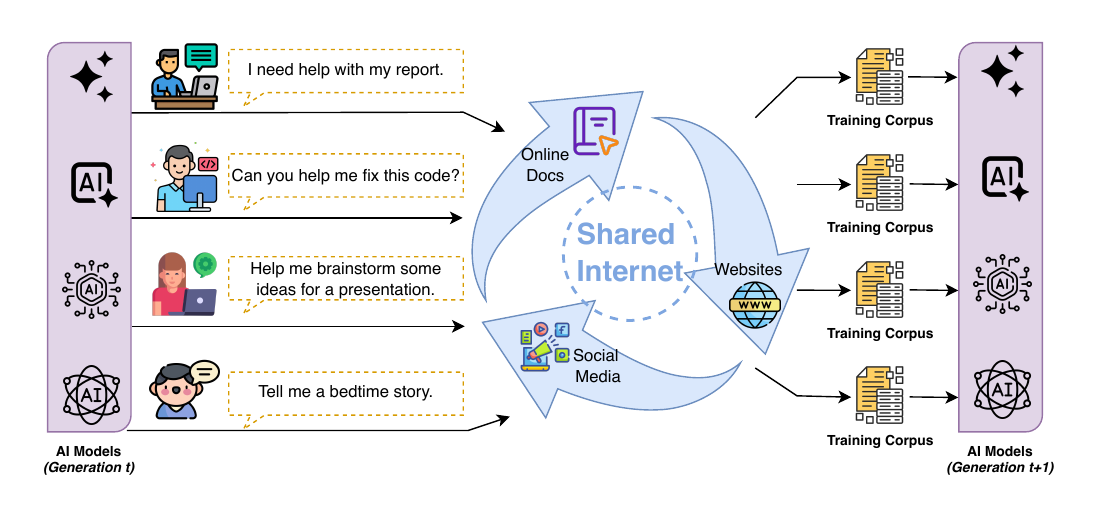
Language models are trained from the web, and then they write back to the web. Their answers show up in posts, docs, code, and datasets. Later crawls may collect them again. We call this data pollination. The paper asks a simple question: if models can influence one another through data, what happens to the next generation? We look at 27 deployed models and run controlled experiments with 320 small language models. The result is a more ecological picture: single recursive chains can collapse, while diverse model populations are much more stable.
The basic idea
Most discussions of synthetic data start with a simple loop. A model trains on its own outputs. Rare patterns disappear. The distribution gets narrower. After several rounds, the model breaks down.
The real web is messier. Many models are used at the same time. People publish the outputs they find useful. Crawlers mix those outputs with human-written text. No lab has to share weights. No model has to call another model directly. The corpus itself becomes the carrier.
Data pollination names this carrier. It moves the question from one training run to the whole environment in which models are used, published, scraped, and trained again.
How we checked it
We use two kinds of evidence. One looks at models already in the world. The other builds a small world where the loop can be controlled.
- In the wild: compare linguistic fingerprints from 27 deployed models across Claude, GPT, Gemma, Llama, and Mistral families.
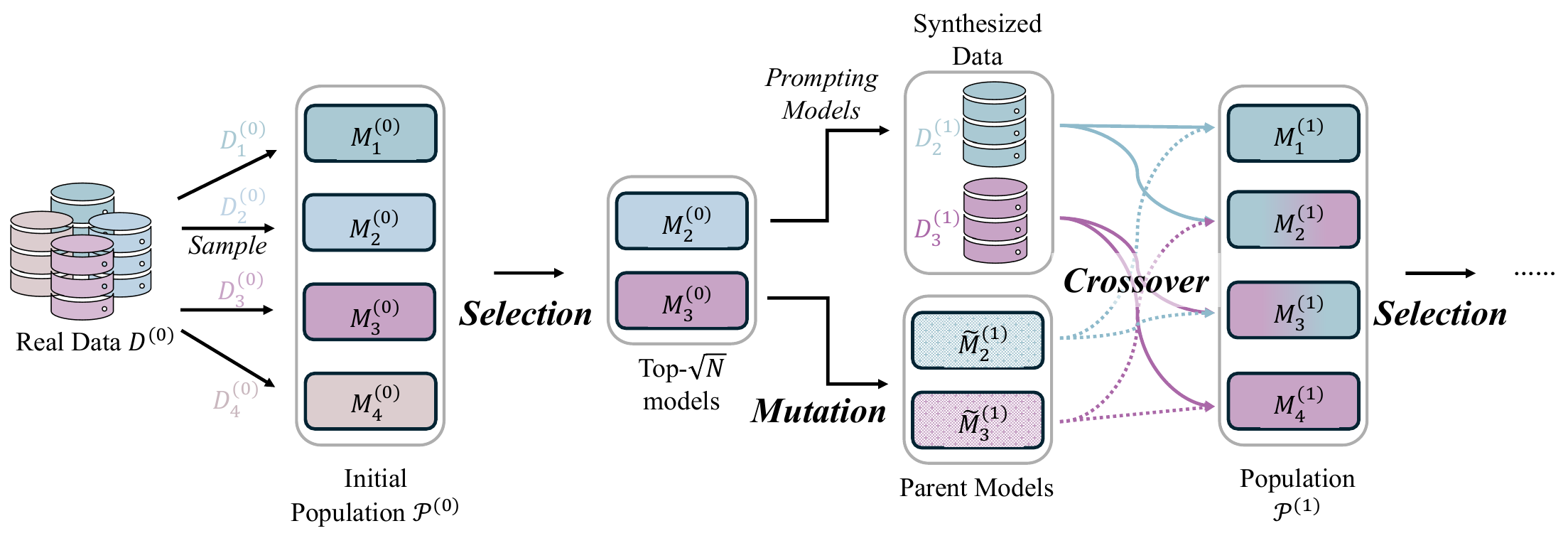
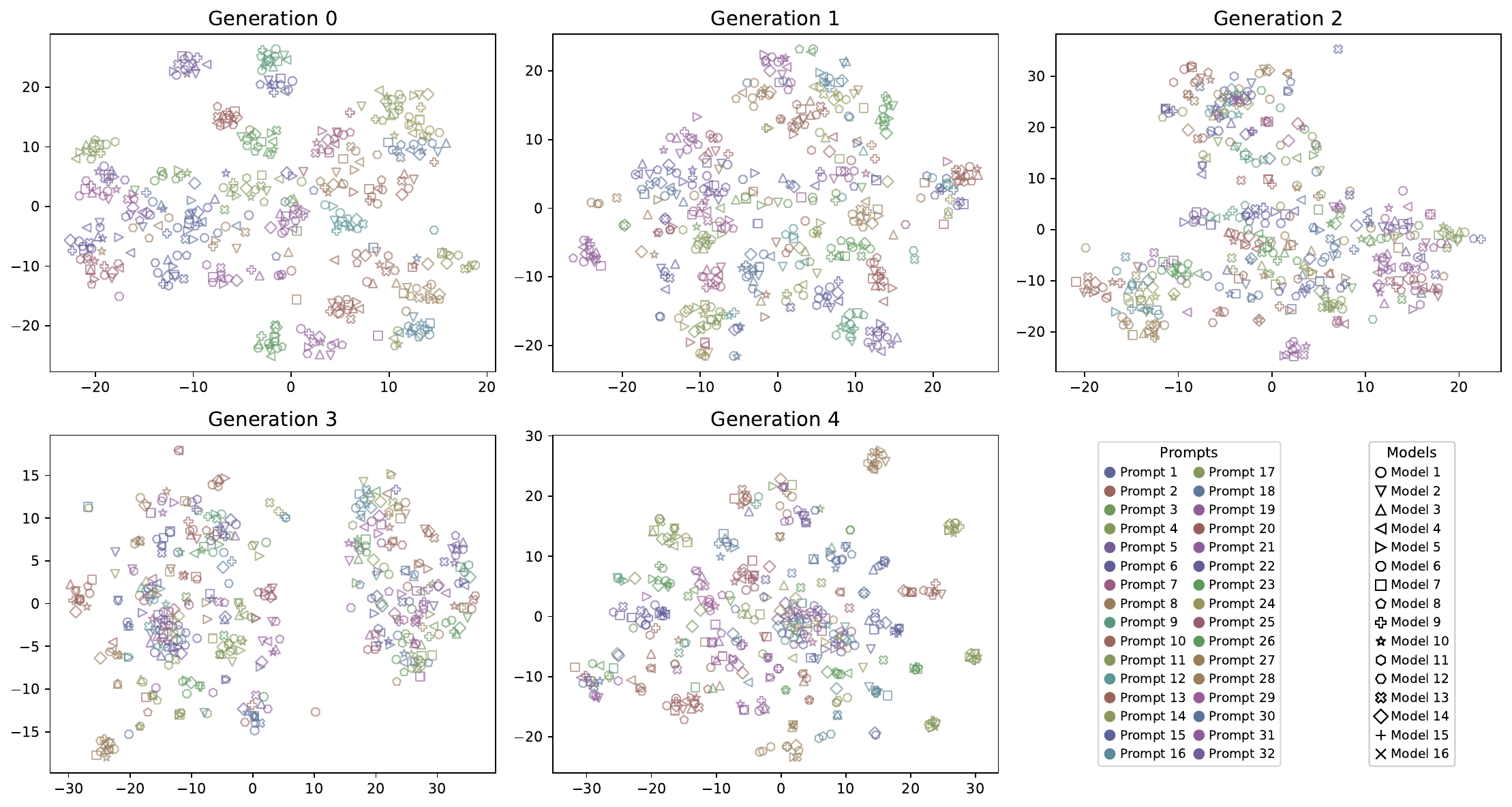
- In the lab: evolve 320 small language models in synthetic-only training, using populations of N = 16 over five generations.
- For mechanism: test diversity with Gaussian analysis, population-size ablations, and semantic embedding visualizations.
The deployed-model analysis is indirect. Without proprietary training corpora, it cannot prove exact data provenance. The controlled synthetic-only experiments test the mechanism under known conditions.
What showed up
1. Model families are less separate than they look
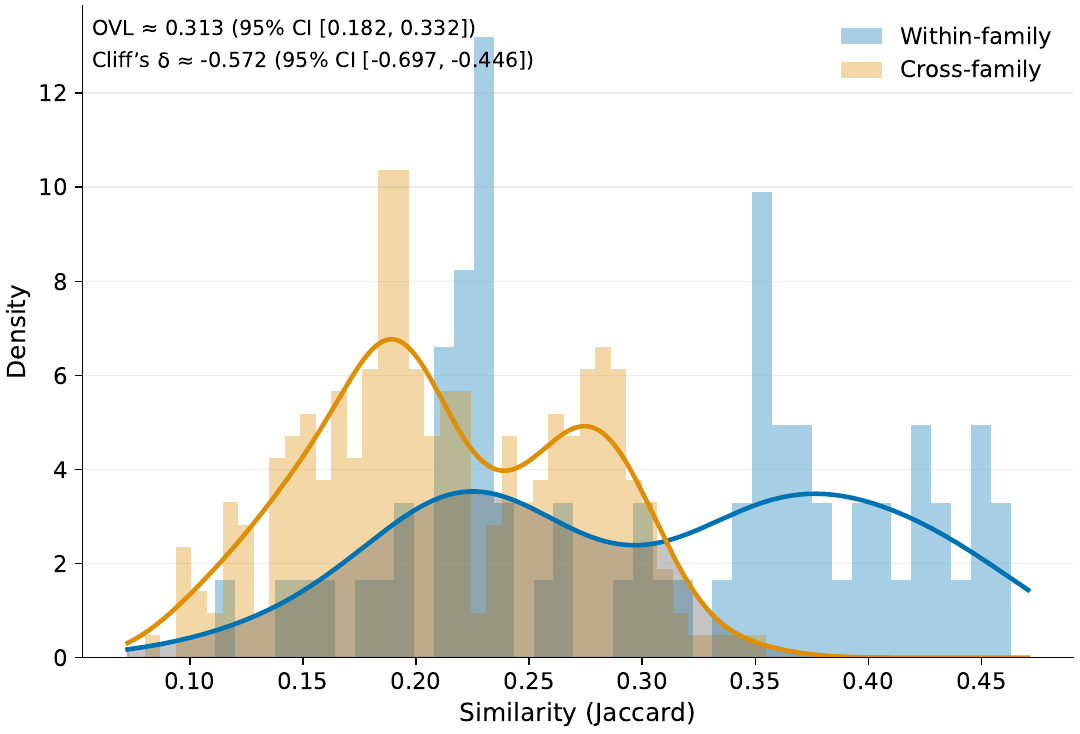
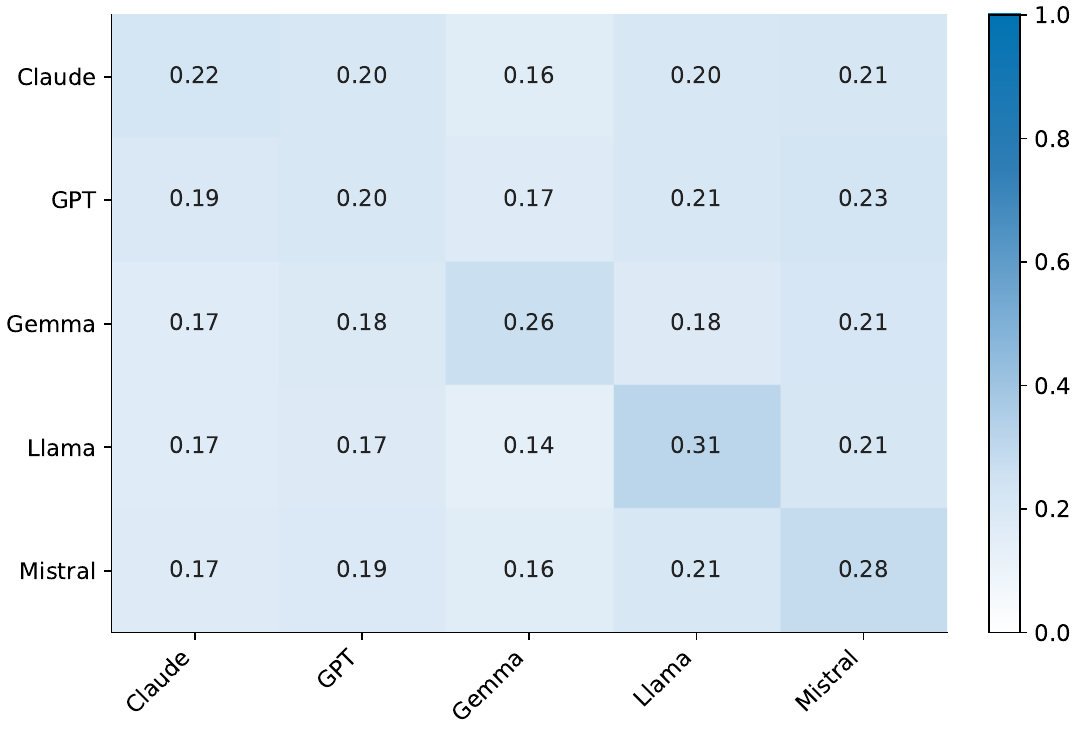
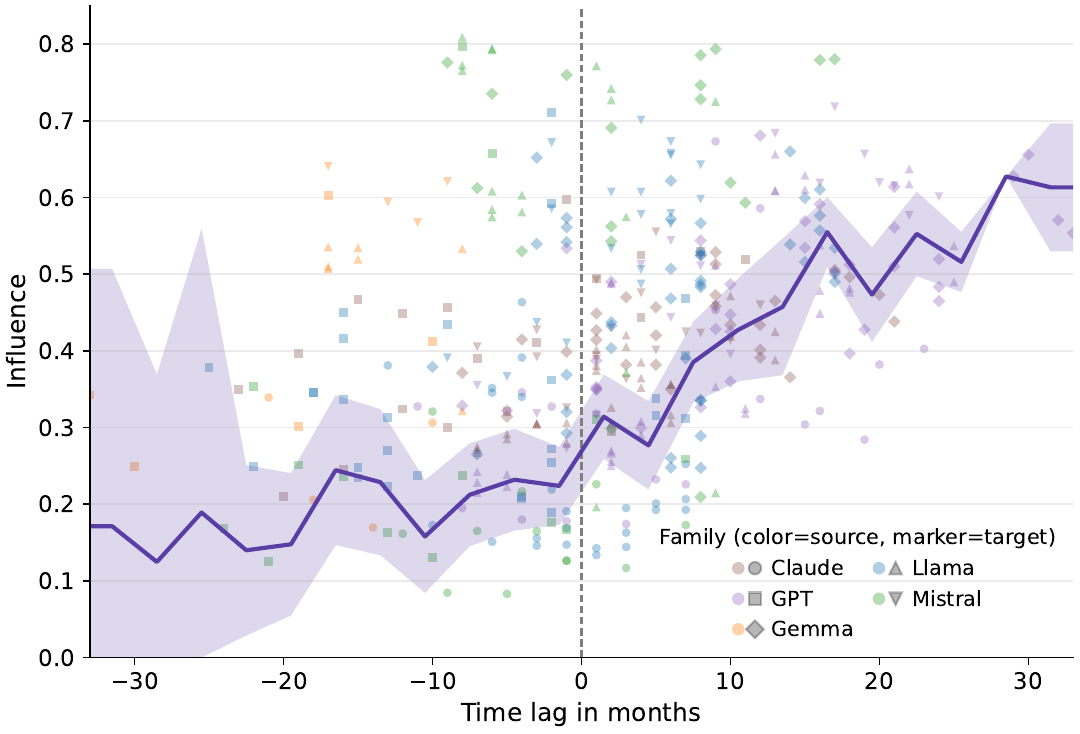
Independent model families should have clearly different fingerprints. In practice, the boundary is blurry. Across 27 deployed models from five families, within-family and cross-family similarities overlap substantially (Overlap Coefficient = 0.313, Cliff's δ = −0.572).
The time direction is the important part. Newer models echo older models more than older models echo newer ones. That pattern fits a world where outputs from earlier deployed systems become part of later training material.
2. A population changes the collapse story
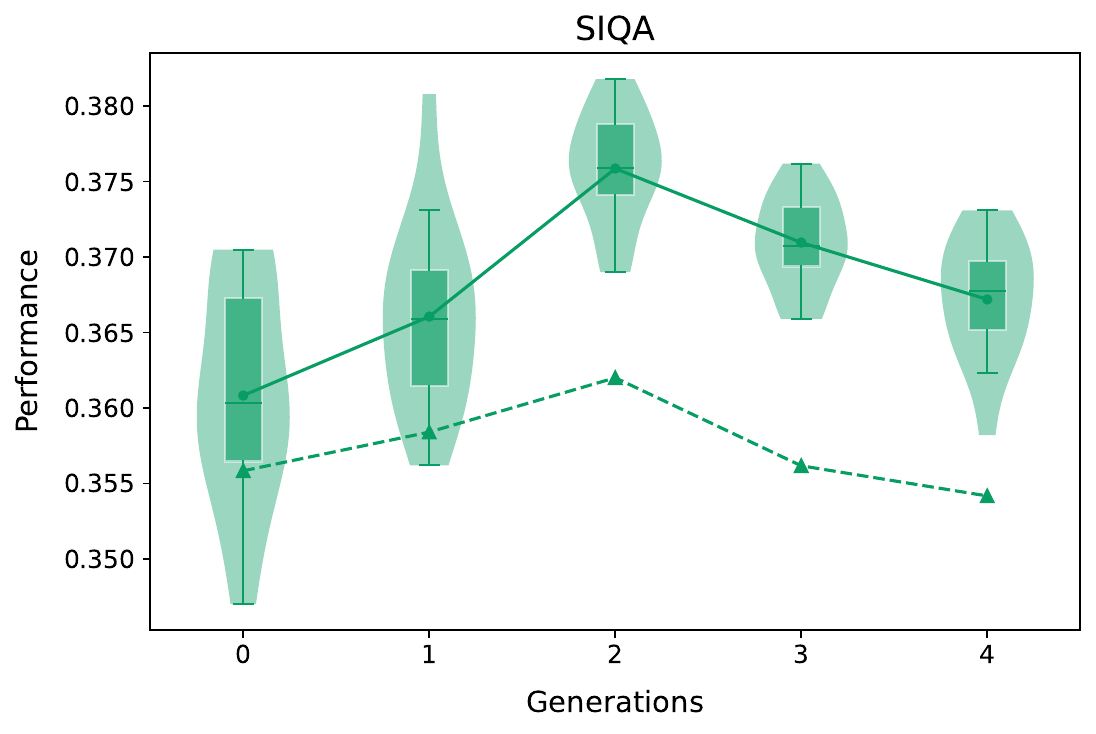
The fragile case is a single lineage feeding on its own distorted outputs. We reproduce that baseline, and it collapses. Then we keep the synthetic-only setting and organize training as a population. Across 320 models, the evolutionary populations stay stable or improve on MMLU, WinoGrande, MathQA, and SIQA. On MMLU and MathQA, performance rises over generations.
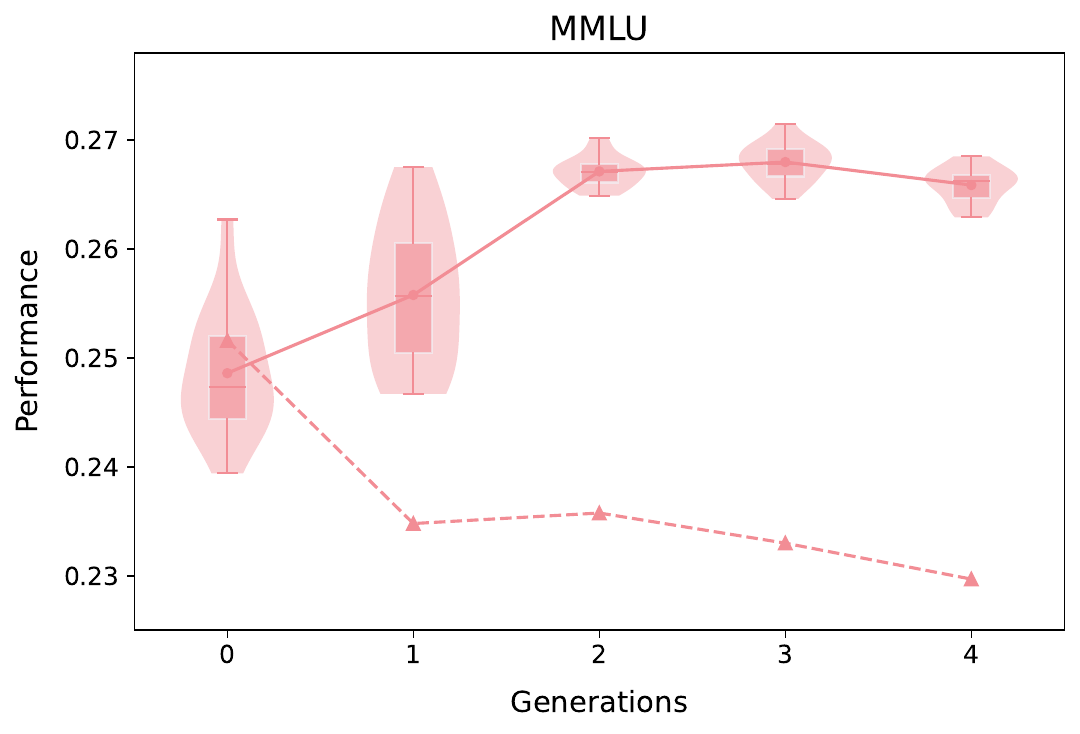
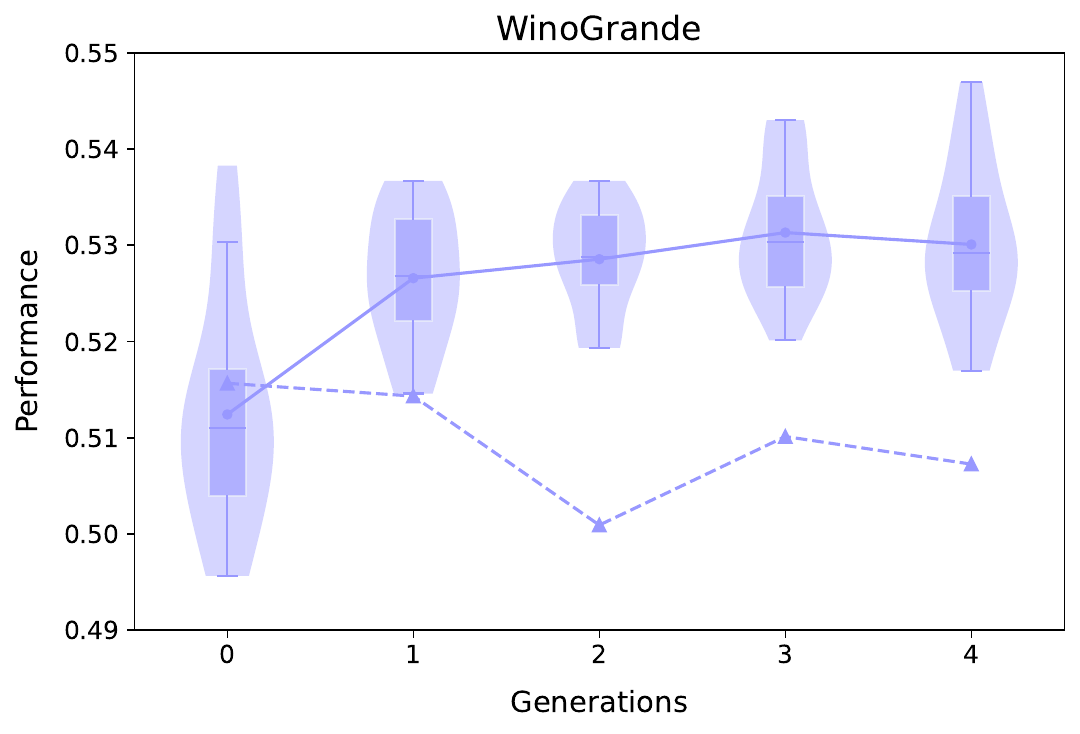
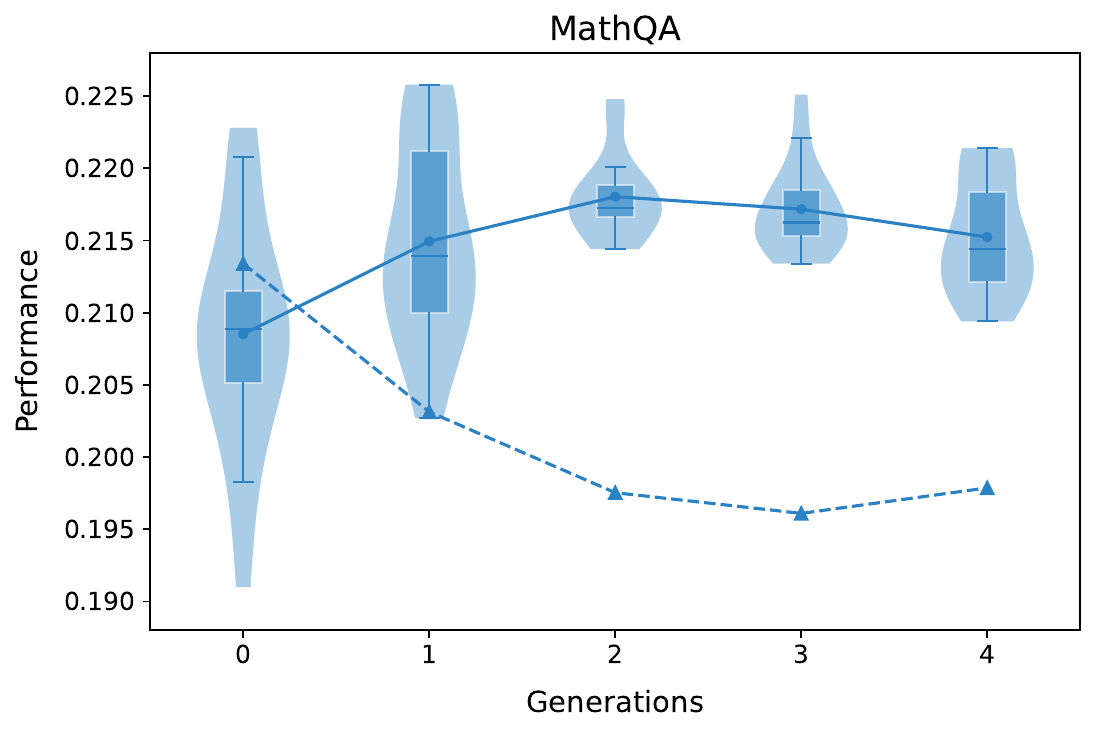
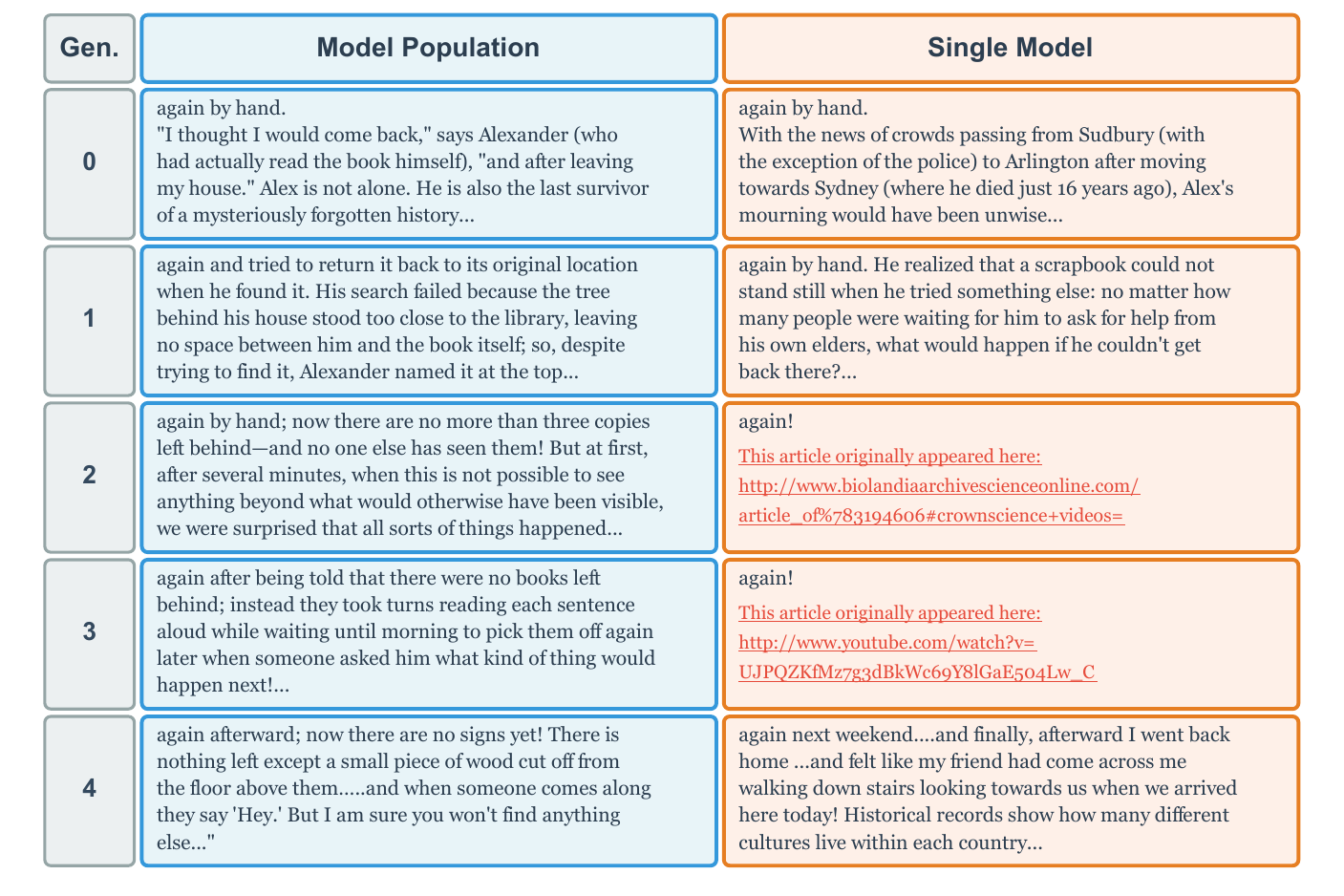
The text samples make the failure mode easy to see. Population-based models stay grammatical and on-topic through generation 4. Single recursive models begin to drift into metadata, URLs, and repeated fragments by generation 2.
3. Diversity supplies the buffer
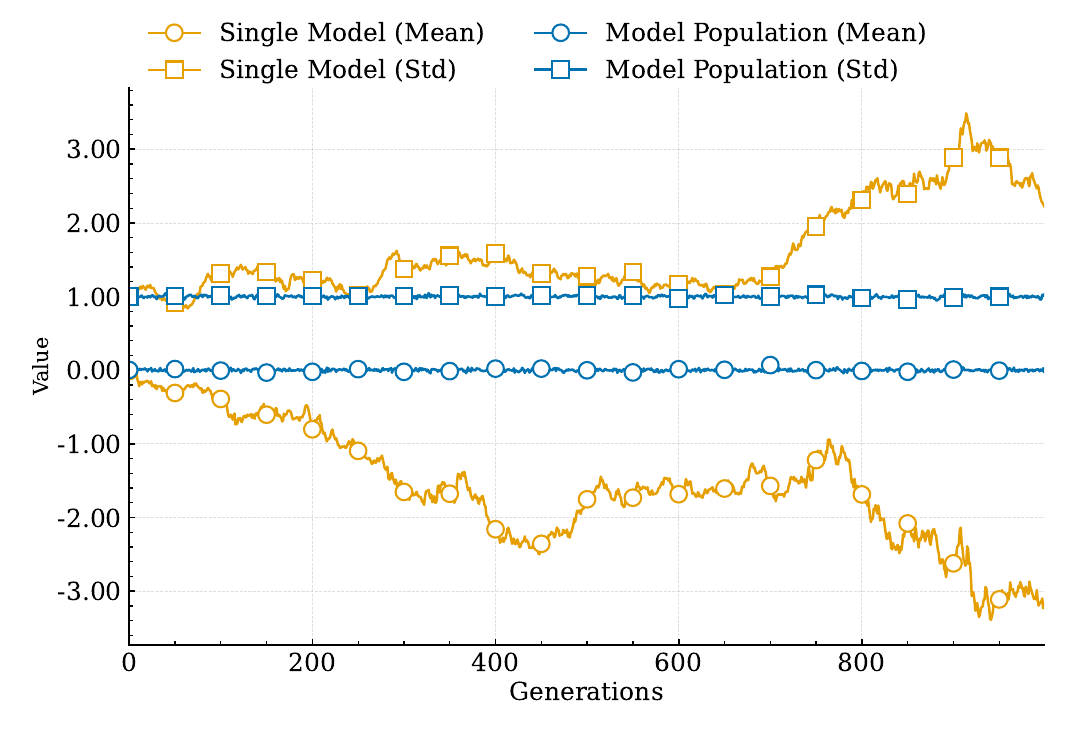
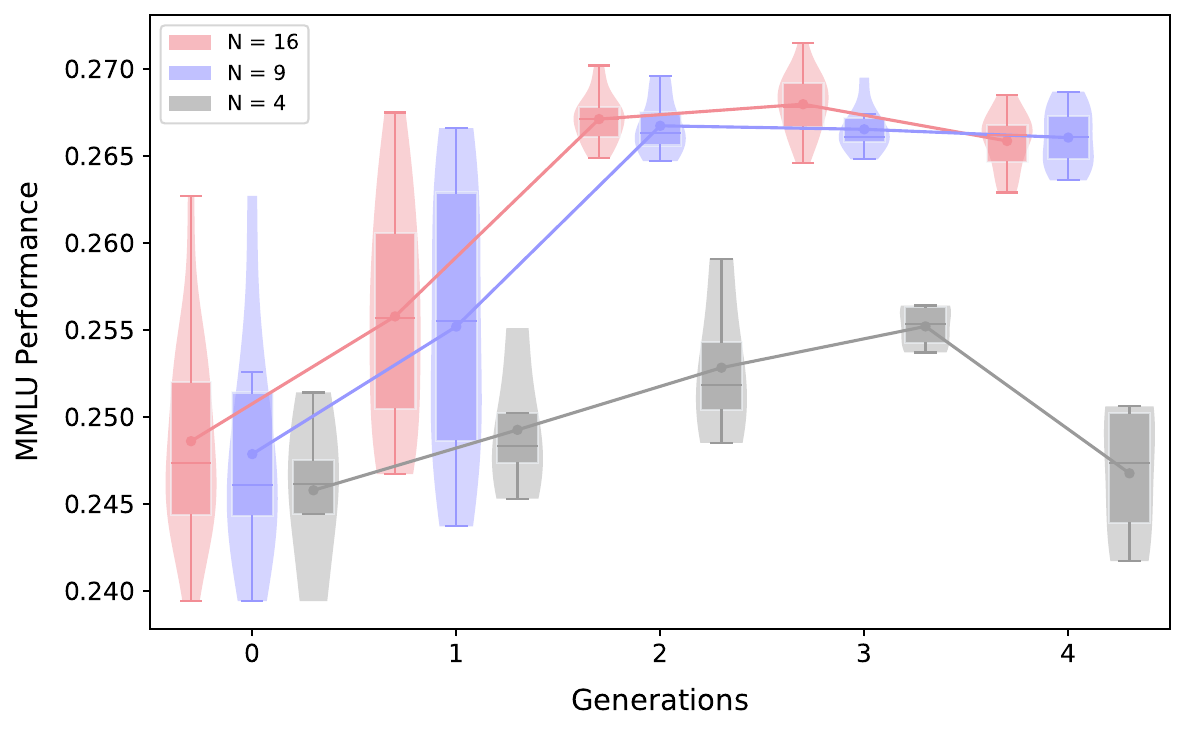
A population does not make every model good. It keeps enough independent lineages alive, so one model's error is less likely to become everyone's error. In a Gaussian setting, the probability that every estimator is bad drops exponentially as the number of estimators grows. The language-model experiments show the same pattern: larger populations preserve stability, while smaller ones stagnate or wobble.
Why this matters
Synthetic data is often discussed as a yes-or-no question. The experiments suggest a more useful question: what kind of ecosystem is the data moving through? A single-family ecosystem can copy the same blind spots everywhere. A diverse population gives alternative behaviors more time to survive.
This makes population structure a design variable. Researchers should study model collapse beyond single recursive chains. Builders should preserve genuinely different data sources, model families, and evaluation signals. Diversity here is infrastructure for resilience.
We do not claim that deployed-model fingerprints prove exact training-set lineage. The controlled models are far smaller than frontier systems. The result is a proof of concept for population dynamics, not a safety guarantee for any production ecosystem.
Short version
- AI models can inherit from one another through public data.
- Single recursive training chains can collapse.
- Diverse model populations are more stable in our controlled setting.
- Future AI systems should be studied as individual models and as populations.
BibTeX
@inproceedings{xie-etal-2026-data,
  title     = {Data Pollination: An Emergent Ecological Process Driving {AI} Population Evolution},
  author    = {Xie, Shufang and Pei, Qizhi and Lv, Ang and Hu, Jingyang
               and Wu, Lijun and Yan, Rui},
  editor    = {Liakata, Maria and Moreira, Viviane P. and Zhang, Jiajun
               and Jurgens, David},
  booktitle = {Proceedings of the 64th Annual Meeting of the {A}ssociation
               for {C}omputational {L}inguistics (Volume 1: Long Papers)},
  year      = {2026},
  month     = jul,
  address   = {San Diego, California, United States},
  publisher = {Association for Computational Linguistics},
  url       = {https://aclanthology.org/2026.acl-long.1229/},
  doi       = {10.18653/v1/2026.acl-long.1229},
  pages     = {26698--26721},
  ISBN      = {979-8-89176-390-6}
}